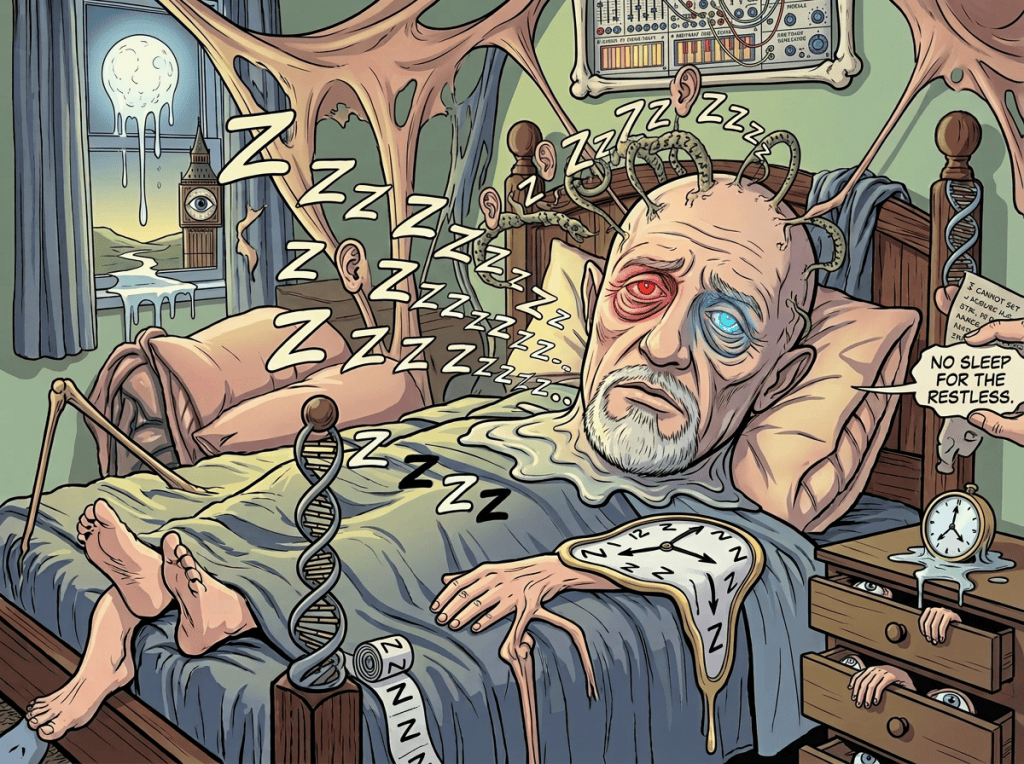
My sleep protocol requires documentation, as it involves several non-standard operational parameters that warrant explanation.
Initiation occurs at precisely 8:45PM. This timing produces a reliable sleep onset window of seven and a half minutes. The procedure mandates beginning in a supine position tilted toward the right side. After two to three minutes of this orientation, lateral rotation to the left side is required. Within two minutes—no more—a return to the right side is mandatory, and this position must be maintained. Once positioned, conscious attention is directed toward the interior visual field, where a starry whirlpool formation materializes and rotates against the darkness of the closed eyelids. I maintain the ability to project arbitrary imagery onto this internal visual surface; it functions as an autonomous visualization apparatus. When this whirlpool pattern dissipates into absence, sleep occurs. I do not subjectively experience the transition into sleep, only infer it has happened retroactively, as no memory of falling asleep is retained.
Protocol deviations occur approximately once per thirty-six sleep cycles. These deviations manifest as a miscalculation in rotational sequence—four or occasionally five rotations instead of the prescribed two-plus-one pattern. Such errors trigger immediate conscious awareness of the mistake, which activates the automatic stress response system. The cerebral function shifts into what can only be described as a grinding state. This is a critical system failure. Locating and engaging the grinding killswitch succeeds approximately one time in thirty-six attempts. When successful, sleep onset proceeds uninterrupted despite the protocol violation. When unsuccessful—the vast majority of instances—the grinding continues unabated, necessitating forced exit from bed after precisely one hour of persistent wakefulness. On weekends, this threshold extends to one hour and thirty minutes. At this point, further sleep attempts become counterproductive.
Now, the situation becomes clinically suboptimal: sleep timing.
I do not sleep longer than two hours in a row. On statistically infrequent occasions, I can extend this to three hours. Very rarely, approximately at a frequency comparable to the 29th of February (this date is arbitrary; one documented occurrence fell on the 12th of March as well), the sleep interval reaches a full four hours. An additional observation: upon waking after the aforementioned 2, 3 or (rarely) 4 hours, I am immediately and fully awake; there is no transitional phase, no requirement for coffee or any other stimulant; instead, I am abruptly and maximally alert, as if no sleep interval had occurred. This remains unexplained.
It must be acknowledged that a total of two hours of sleep is insufficient. Consequently, after my midday meal – which functionally serves as breakfast – preferably at 11:45 AM (the recurring three-quarters-of-an-hour offset noted previously), I schedule a nap. This nap has a planned duration of precisely one hour, subject to the usual variance. Unlike the nocturnal awakenings described above, emergence from this nap is characterized by pronounced residual fatigue: for the remainder of the day, both body and mind exhibit reduced operational capacity, with a persistent subjective impression that a potentially productive afternoon has been compromised solely by the decision to nap. This is suboptimal but reproducible. The sense of drag diminishes as the time approaches 17:00 hours, which, within my personal routine, is designated as gin-and-tonic time.
For the record: my physician has classified this sleep pattern as “really not normal and absolutely unhealthy” and has further remarked that “after all these decades of sleep deprivation, you should actually be dead.” Empirically, this prediction has not yet been borne out; observation continues.
The rationale for documenting these observations is straightforward, dear reader (whose presence is acknowledged as part of the intended audience).
They constitute the operational explanation for how the necessary time is obtained to produce these texts and to create the accompanying images; the hours in question are not found but reallocated from the standard human sleep budget.
I did not smoke today.
 Vita Magna Est
Leave a comment